Done in our Fort Lauderdale office by Dr. Michael Erdman, fellowship-trained in interventional spine and pain medicine
Kyphoplasty (say KY-fo-plas-tee) is a procedure for a painful compression fracture in the spine. A compression fracture is when one of the bones of the spine, called a vertebra, cracks and collapses. It often happens in older adults whose bones are weak from osteoporosis.
Dr. Michael Erdman at IROSM in Fort Lauderdale does kyphoplasty in our office with numbing medicine, and patients go home the same day. Many people who read this page are looking into it for a parent. This guide is written for you too.
Important Notice from IROSM: Kyphoplasty is not right for every spine fracture. After reviewing the imaging and doing an exam at IROSM in Fort Lauderdale, Dr. Michael Erdman explains whether kyphoplasty, a brace and other non-surgical care, or a visit with a spine surgeon is the better fit.
What Is Kyphoplasty?
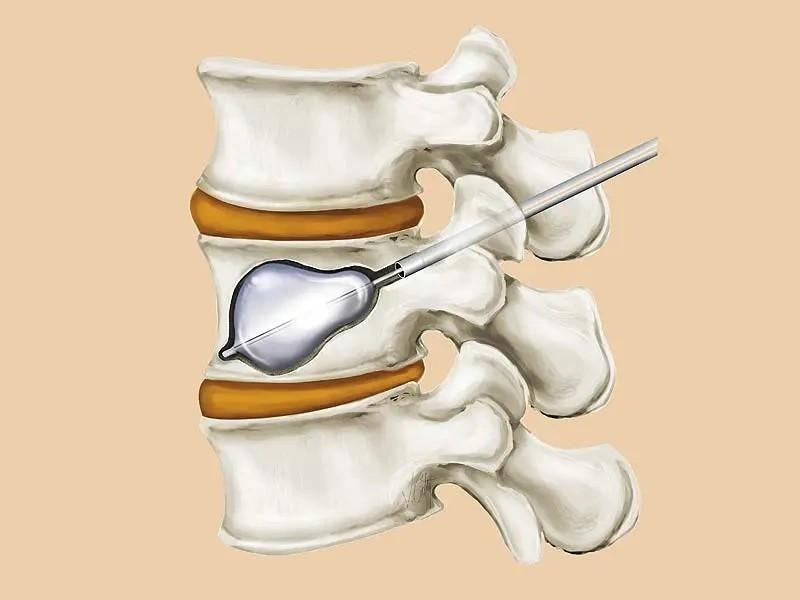
Kyphoplasty is a procedure that puts bone cement into a broken spine bone to support it. Through a small needle in the back, the doctor passes a tiny balloon into the collapsed bone. The balloon is gently filled to make a space, then taken out, and the space is filled with bone cement that hardens. X-ray pictures guide each step.
The goal is to steady the broken bone and ease pain, so moving, sleeping and daily care get easier. Kyphoplasty does not treat the weak bones that caused the fracture. That needs its own care, explained below. To learn more about the fracture itself, see what a spinal compression fracture is and how it is treated.
Who May Kyphoplasty Be Considered For?
Kyphoplasty may be considered for a painful compression fracture that shows on imaging, often in an older adult with osteoporosis. It is used when the pain makes it hard to move, sleep or care for yourself. Dr. Erdman usually looks for:
A fracture seen on an X-ray, CT scan or MRI
Pain that matches the broken bone on the exam
A fracture that has not healed yet. An MRI often helps show this.
Pain that is not controlled well enough with a brace, medicine and time
Kyphoplasty is usually not used for a fracture that has already healed or one that presses on the spinal cord or nerves. It is also not used when there is an infection. Some fractures need a spine surgeon instead. Read when a spine fracture needs surgery.
What Happens on the Day at IROSM
Dr. Erdman does kyphoplasty in our Fort Lauderdale office at 3333 West Commercial Blvd. Patients go home the same day.
Numbing: the skin and tissue over the fracture are numbed with local anesthesia (numbing medicine). This is not general anesthesia, and you are not put to sleep through an IV.
Medicine before the procedure: some patients are also given medicine to take by mouth shortly before, to help with anxiety and pain. Dr. Erdman decides if this fits you and gives you your own instructions.
The procedure: guided by X-ray pictures, a small needle reaches the broken bone, the balloon makes a space, and the cement is placed.
Afterward: you rest while our team checks on you, then you go home.
A ride home: plan for a responsible adult to drive you home. The medicine taken before the procedure makes driving unsafe.
Recovery After Kyphoplasty
Recovery is different for everyone. Many patients go home the same day and start with light walking. Dr. Erdman tells you when to do more, when to return to normal activities, and what to avoid for now, such as heavy lifting.
Some back pain can continue after kyphoplasty. It may come from the fracture, the back muscles or another part of the spine. Tell us if pain continues or changes. For pain in the middle of the back, see mid-back pain treatment.
Call 911 or go to the emergency room for chest pain or trouble breathing. Call us right away for fever, new weakness or numbness in the legs, loss of bladder or bowel control, or sudden new back pain.
What Are the Risks of Kyphoplasty?
Kyphoplasty is done through a needle, not open surgery, but it is not risk-free. Possible risks include:
Cement leaking outside the bone: this often causes no symptoms. Rarely, cement can press on a nerve or travel through a blood vessel to the lungs.
Infection or bleeding where the needle went in
Nerve irritation, which can cause new pain or tingling
New fractures in nearby spine bones: weak bones can break again. Research has not shown clearly whether kyphoplasty adds to this risk.
Reactions to medicines used before or during the procedure
Dr. Erdman goes over your own risks, based on your health and your imaging, before you decide.
Does Kyphoplasty Work?
For some people it helps, but the research is mixed. In a large study, people who had kyphoplasty felt better and moved more easily in the first month than people who had non-surgical care. But studies of vertebroplasty, a close cousin of kyphoplasty, that compared it with a fake procedure found little or no extra benefit.
A bone health expert group has said the evidence does not support using these procedures routinely. It also said anyone offered one should get the full picture. That is why Dr. Erdman decides one patient at a time and explains every option, including not having the procedure. The studies are listed below.
Kyphoplasty, Vertebroplasty or a Brace?
Option
What it is
How it is done
Kyphoplasty
A balloon makes a space in the broken bone, then bone cement fills it
Small needle, numbing medicine, X-ray guidance
Vertebroplasty
Bone cement goes into the broken bone without a balloon first
Small needle, numbing medicine, X-ray guidance
Brace and other non-surgical care
A back brace, pain medicine, gentle activity and therapy while the bone heals
No procedure
A brace and other non-surgical care may be the right fit, depending on the fracture and your symptoms. None of these options treats osteoporosis itself. Which option fits is decided at your evaluation.
Protecting Your Bones After a Spine Fracture
A compression fracture is often the first sign of osteoporosis, and it raises the chance of another fracture. It should lead to a check of bone health. Dr. Erdman can identify this need and work with your primary care doctor or an osteoporosis specialist for a bone density test and treatment. Bone medicines can lower the risk of another spine fracture (see the research below). For the longer view, read about life after a compression fracture.
Preventing falls matters too:
Remove loose rugs and clutter from walkways
Add night lights and grab bars in the bathroom
Wear sturdy shoes with good grip
Ask the doctor to check medicines that cause dizziness, and get eyes checked
For Families: How to Help a Parent
You can call us at (954) 751-6990 to ask about scheduling and how the evaluation works, even if you live in another state. To discuss your parent’s private medical information, we need your parent’s permission, or you need the right legal authority.
Imaging: ask the imaging center for the radiology report and the actual CT or MRI images, not just the report.
Referral: if your parent’s health plan needs one, ask their primary care doctor to send it. A useful referral includes the medical history, the imaging report and images, a medication list, and the doctor’s contact details. Referring doctors can call (954) 751-6990.
What are the risks for my parent, given their other health problems?
Should any medicines, such as blood thinners, be stopped first?
What help will my parent need at home afterward?
How will we check and treat their bone health?
Who do we call if the pain changes?
What the Research Says About Kyphoplasty
Kyphoplasty compared with non-surgical care: A study randomly split 300 adults with new spine compression fractures into two groups: kyphoplasty or non-surgical care. After one month, the kyphoplasty group scored better on a measure of physical quality of life. The study was funded by a kyphoplasty maker. Wardlaw D, et al. Efficacy and safety of balloon kyphoplasty compared with non-surgical care for vertebral compression fracture (FREE): a randomised controlled trial. Lancet. 2009;373(9668):1016-1024. View the study.
Vertebroplasty compared with a fake procedure: A review of five studies compared vertebroplasty, a close cousin of kyphoplasty, with a fake (placebo) procedure. People in both groups improved, and vertebroplasty gave no important extra benefit for pain, daily function or quality of life after one month. Buchbinder R, et al. Percutaneous vertebroplasty for osteoporotic vertebral compression fracture. Cochrane Database Syst Rev. 2018;11:CD006349. View the study.
Very painful, very new fractures: A study of 120 people in the hospital with very painful spine fractures less than six weeks old compared vertebroplasty with a fake procedure. After two weeks, more people in the vertebroplasty group had low pain (44% compared with 21%). Clark W, et al. Safety and efficacy of vertebroplasty for acute painful osteoporotic fractures (VAPOUR): a multicentre, randomised, double-blind, placebo-controlled trial. Lancet. 2016;388(10052):1408-1416. View the study.
An expert review of the evidence: A task force of the American Society for Bone and Mineral Research found there was not enough evidence that kyphoplasty works better than non-surgical care. It said routine use is not supported. When it is offered, patients should be fully informed. The group also found bone medicines lower the risk of another spine fracture by 40% to 70%. Ebeling PR, et al. The Efficacy and Safety of Vertebral Augmentation: A Second ASBMR Task Force Report. J Bone Miner Res. 2019;34(1):3-21. View the study.
Kyphoplasty in Fort Lauderdale
Dr. Michael Erdman evaluates spine compression fractures and performs kyphoplasty at our Fort Lauderdale office for patients from across Broward County. Dr. Erdman speaks English and Spanish.
Institute of Regenerative Orthopedics & Sports Medicine (IROSM)
3333 West Commercial Blvd, Suite 101
Fort Lauderdale, FL 33309
Phone: (954) 751-6990
Frequently Asked Questions About Kyphoplasty
What is kyphoplasty?
What is kyphoplasty?
Kyphoplasty is a procedure for a painful spine compression fracture. Through a small needle, a balloon makes a space in the broken bone, and bone cement fills it to support the bone. X-ray pictures guide each step.
Is kyphoplasty safe for older adults?
Is kyphoplasty safe for older adults?
Kyphoplasty is often done in older adults, but it is not risk-free. Risks include cement leaking outside the bone, infection, bleeding and new fractures nearby. Dr. Erdman reviews your parent's health and imaging and explains their own risks before deciding.
Is kyphoplasty a major surgery?
Is kyphoplasty a major surgery?
No. It is done through a small needle with numbing medicine in our Fort Lauderdale office, and patients go home the same day. It still has risks, which Dr. Erdman explains before you decide.
What is recovery like after kyphoplasty?
What is recovery like after kyphoplasty?
Recovery is different for everyone. Many patients go home the same day and start with light walking. Dr. Erdman tells you when to do more and what to avoid for now, such as heavy lifting.
How long does pain last after kyphoplasty?
How long does pain last after kyphoplasty?
It varies. Some people feel less pain soon after, some improve slowly, and some still have back pain from other causes. Tell Dr. Erdman if pain continues or gets worse.
How long does kyphoplasty last?
How long does kyphoplasty last?
The cement hardens and stays in the treated bone. It does not prevent new fractures in other spine bones, so checking and treating bone health and preventing falls are important.
Can kyphoplasty treat an older fracture?
Can kyphoplasty treat an older fracture?
Sometimes. It is mainly used for a fracture that has not healed yet, which an MRI can help show. A fracture that has already healed is usually not treated with kyphoplasty.
What is the success rate of kyphoplasty?
What is the success rate of kyphoplasty?
There is no single success rate. Results depend on the fracture, how long it has hurt and the person's health, and the research is mixed. Dr. Erdman explains what the studies show for your situation.
What is the difference between kyphoplasty and vertebroplasty?
What is the difference between kyphoplasty and vertebroplasty?
Both put bone cement into a broken spine bone through a needle. In kyphoplasty, a small balloon first makes a space in the bone. Which option fits is decided at your evaluation.
Who performs kyphoplasty at IROSM?
Who performs kyphoplasty at IROSM?
Dr. Michael Erdman, a board-certified family medicine physician with ACGME-accredited fellowship training in interventional spine and pain medicine, performs kyphoplasty in our Fort Lauderdale office. He speaks English and Spanish.
Can I call about my parent's care?
Can I call about my parent's care?
Yes. Family members can call (954) 751-6990 to ask about scheduling and the evaluation process. To discuss private medical information, we need the patient's permission, or the caller must have the right legal authority.
Does Medicare cover kyphoplasty?
Does Medicare cover kyphoplasty?
Medicare may cover a kyphoplasty when it is medically necessary and applicable coverage criteria are met. Our team reviews the patient's clinical information, imaging, and insurance benefits before scheduling. Coverage and out-of-pocket costs vary.
Do I need a referral to be seen at IROSM?
Do I need a referral to be seen at IROSM?
It depends on your insurance. Many HMO, Medicare Advantage and Medicaid plans need a referral from your primary care doctor before you see a specialist. Please check with your plan, or call us at (954) 751-6990 before your visit to confirm.
Talk With Dr. Erdman About Kyphoplasty
Board-certified in family medicine · Fellowship-trained in interventional spine and pain medicine · Fort Lauderdale & Hialeah
Call (954) 751-6990 to ask about an evaluation at our Fort Lauderdale office. Family members are welcome to call about scheduling. Same-week appointments are usually available.
Medically reviewed by:Dr. Michael Erdman Institute: Institute of Regenerative Orthopedics & Sports Medicine (IROSM)
Last reviewed: September 2026
Disclaimer: This content is for general educational purposes and does not constitute formal medical advice. Individual patient outcomes will vary. Kyphoplasty at IROSM in Fort Lauderdale requires a clinical examination by Dr. Michael Erdman to establish candidacy. Serving Fort Lauderdale and surrounding Broward County communities.