- info@irosm.com
- 3333 West Commercial Blvd , Ste 101 Fort Lauderdale , Fl, 33309
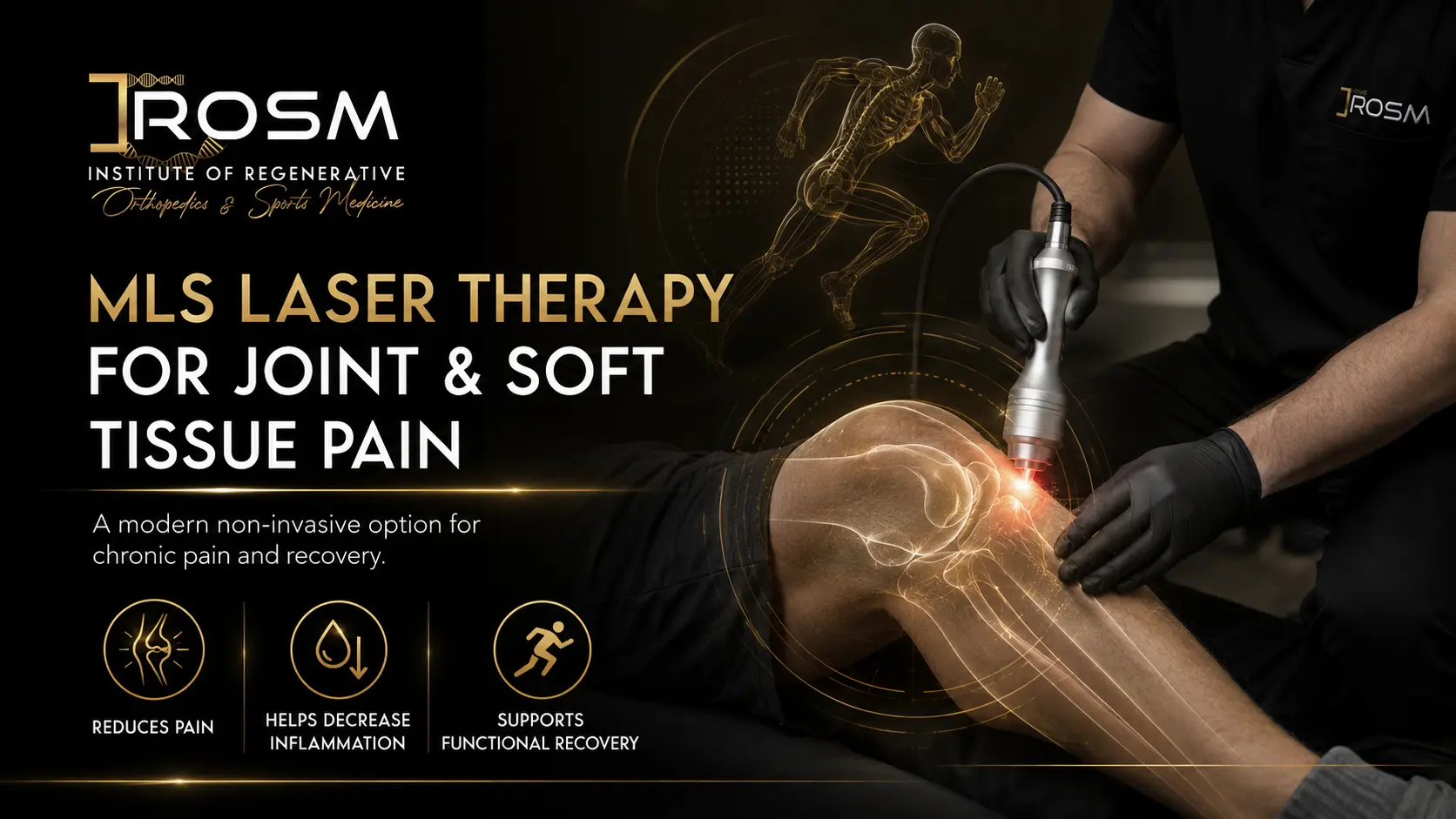
Class IV MLS laser therapy at the Institute of Regenerative Orthopedics and Sports Medicine (IROSM) in Fort Lauderdale uses therapeutic light to treat painful or injured tissue. There are no needles, no cuts and no downtime for most patients. This page explains how it works, who may be a candidate and what a visit looks like.
Care is led by Dr. Jorge Gonzalez, a triple board-certified physician who is fellowship-trained at the Andrews Institute and has treated professional MLB and NFL athletes.
NFL veteran Carl Lawson added Class IV MLS laser therapy at IROSM in Fort Lauderdale to his off-season recovery routine. In this short video, he and Dr. Jorge Gonzalez talk about how the laser fits alongside physical therapy, massage and other recovery tools. Learn more about sports medicine in Fort Lauderdale at IROSM.
“The work is important, but what’s most important to get out of work is recovery.” Carl Lawson, NFL veteran and IROSM patient
Carl Lawson uses MLS laser therapy at IROSM alongside his training, physical therapy and massage. Dr. Gonzalez uses the same Class IV MLS laser for patients with joint, tendon, muscle and spine pain in Fort Lauderdale, as part of a broader non-surgical plan.
Dr. Jorge Gonzalez: All right, guys. I have here one of our favorite patients. Most of the people watching know who he is: Carl Lawson. He wanted to talk about our new Class IV medical-grade laser. We’re using it for many conditions in orthopedics, sports medicine and spine medicine. We also wanted to showcase it because we’re using it with him for recovery in general. He’s an NFL veteran of over 10 years, so his body has a lot of wear and tear. In the off-season he’s training and getting his body ready, and we’re noticing his recovery has been a little easier by adding the laser to his toolbox, the same way we would use physical therapy, massage therapy, sauna and everything else we have to aid recovery. The laser is another component to help heal and help with recovery in general. So tell us a little about what you’ve seen this off-season in your recovery, compared to before.
Carl Lawson: What I’ve been seeing is an ability to recover from work. I’ve had previous injuries in the past, and you want to keep those things fresh. The work is important, but what’s most important to get out of work is recovery. So having a device like this makes me able to work more, so I can have more adaptation to be a better athlete. I really appreciate Doc for bringing this in, taking his time and doing detailed research to actually get this going for his clients. You can tell he cares, and you can tell he took time when he got this for us.
Dr. Jorge Gonzalez: Couldn’t say it any better. Thank you, Carl. Anybody interested in laser therapy, we have it available in South Florida. Just give us a call. Thank you.
This video shares one patient’s experience. Individual results vary, and MLS laser therapy is not right for every patient or condition.
Class IV MLS laser therapy is a medical laser treatment offered at IROSM in Fort Lauderdale. MLS stands for Multiwave Locked System. The laser sends two synchronized wavelengths of light into the painful area to help calm pain and inflammation.
Doctors group this kind of treatment under photobiomodulation (using light to change how cells behave). Unlike pills or shots, MLS laser therapy does not need a needle, a cut or anesthesia. It is one of several non-surgical options at IROSM. You can compare it with other options on our PRP vs stem cell vs laser therapy guide.
This short video explains how MLS laser technology at IROSM in Fort Lauderdale sends therapeutic light into tissue, and what a treatment session generally looks like.
Video shown for educational purposes. Individual treatment plans and results vary.
MLS laser therapy at IROSM delivers light energy to the painful area. In the right patients, it may help in four ways:
MLS laser therapy may help calm pain signals and improve comfort in some chronic and recent muscle and joint problems.
Laser therapy is often used to help settle the inflammation (swelling and irritation) that adds to pain and stiffness.
MLS laser therapy may be used alongside rehab to support the body’s natural healing in tendons, ligaments and muscles.
The laser is applied over the skin. There is no shot, no cut and no surgical recovery, so most patients go straight back to their day.
MLS laser therapy at IROSM in Fort Lauderdale may be an option for patients with:
MLS laser therapy may not be appropriate for everyone. Dr. Gonzalez performs an in-person evaluation to confirm whether it fits your condition, and will tell you plainly if another approach is a better fit.
MLS laser therapy at IROSM in Fort Lauderdale uses two synchronized wavelengths instead of a single beam. One is aimed at pain and the other at inflammation, and they are delivered together.
Each session is set up for the painful area, how deep the tissue is, your comfort and your goals. Settings may change depending on whether the aim is pain relief, calming inflammation, or support during rehab.
Dr. Gonzalez reviews your symptoms, medical history and past treatments, and examines the painful area. Bring any recent X-rays or MRI reports and a list of your current medications.
If MLS laser therapy fits, you get a plan that explains how many sessions may be needed and what it costs. Some patients need a series of sessions rather than one. If it does not fit, we will tell you.
The laser head is held over or moved across the painful area. You wear protective glasses. Most sessions are comfortable and do not need anesthesia.
MLS laser therapy is often paired with rehab, strength work, activity changes, PRP therapy in Fort Lauderdale or other treatments, depending on your diagnosis. Progress is checked at follow-up visits, and response varies from patient to patient.
The number of MLS laser therapy sessions at IROSM depends on your condition, how severe it is, how long you have had it and how you respond. Recent injuries may need fewer sessions. Long-term pain or wear-and-tear conditions often need a series.
Some patients notice a change early, while others improve gradually over several sessions. Timing varies by patient and condition, and your plan is adjusted based on your progress.
MLS laser therapy at IROSM is generally well tolerated when performed with proper settings and safety steps. Protective glasses are required because therapeutic lasers can harm the eyes.
Laser therapy may not be appropriate over certain areas or for certain patients. This includes areas with active cancer, over the belly during pregnancy, and some light-sensitivity conditions. That is why an evaluation comes first.
MLS laser therapy at IROSM in Fort Lauderdale is not the same as a steroid shot, a PRP shot, a nerve block or surgery. It is a non-invasive treatment that may help reduce pain and support recovery. It does not structurally repair every injury or reverse advanced arthritis.
For many patients, laser therapy works best as one part of a broader plan. That plan may include rehab, image-guided injections, orthobiologic treatments, bracing and activity changes.
Dr. Jorge A. Gonzalez is fellowship-trained at the Andrews Institute and has treated professional athletes, including NFL players who use MLS laser therapy as part of their recovery.
MLS laser therapy at IROSM starts with an orthopedic evaluation, so the laser is aimed at a confirmed problem, not a guess.
Laser therapy sits alongside rehab, image-guided injections and regenerative options under one roof, so your plan can change as you progress.
Not everyone is a candidate, and we say so. If your condition is better suited to another approach, including surgery, Dr. Gonzalez will explain why and help with a referral.
Source: Arroyo-Fernández R, et al. High-Intensity Laser Therapy for Musculoskeletal Disorders: A Systematic Review and Meta-Analysis of Randomized Clinical Trials. J Clin Med. 2023. View the study.
Source: Labanca L, et al. Effects of MLS Laser on pain, function, and disability in patients with non-specific chronic low back pain. 2024. View the study.
Source: Arefi S, et al. MLS Laser Reduce Pain in Patients with Chronic Low Back Pain. 2025. View the study.
Source: Song HJ, et al. Effectiveness of high-intensity laser therapy in the treatment of musculoskeletal disorders. Medicine. 2018. View the study.
Source: González-Muñoz A, et al. Efficacy of Photobiomodulation Therapy in the Treatment of Pain and Inflammation. Healthcare. 2023. View the study.
MLS laser therapy at IROSM is offered in Fort Lauderdale for patients across Broward and Miami-Dade County, including Hialeah, Miami, Pompano Beach, Plantation, Coral Springs, Hollywood, Lauderdale Lakes, Oakland Park, Sunrise, Weston and surrounding South Florida communities.
Institute of Regenerative Orthopedics & Sports Medicine
3333 West Commercial Blvd, Suite 101
Fort Lauderdale, FL 33309
Phone: (954) 751-6990
Hialeah
777 E 25th St, Suite 508
Hialeah, FL 33013
Se habla español.
★★★★★ Rated 5.0 out of 5 by patients on Google
Triple board-certified physician • Non-invasive and drug-free • Same-week appointments usually available
A consultation tells you whether MLS laser therapy fits your condition, how many sessions may be needed, and what it costs.

Disclaimer: This page is for general educational purposes and is not medical advice. Individual results vary. Class IV MLS laser therapy is not appropriate for every condition or patient; suitability is determined through clinical evaluation. Patient videos reflect one person’s experience. Serving Fort Lauderdale, Oakland Park, Lauderdale Lakes, Tamarac, and surrounding Broward County communities.