- info@irosm.com
- 3333 West Commercial Blvd , Ste 101 Fort Lauderdale , Fl, 33309

A lump on the side or front of your knee, pain when you squat or kneel, or a knee that feels tight can all come from a cyst. Most knee cysts are benign, but some press on nearby tissue or signal a problem inside the joint, such as a meniscus tear. An evaluation helps find the cause and whether treatment is needed.
At the Institute of Regenerative Orthopedics & Sports Medicine (IROSM), Dr. Jorge Gonzalez, MD at IROSM in Fort Lauderdale uses high-resolution ultrasound to look at knee cysts in the office and, for appropriate candidates, drain them with a needle under local anesthetic, without surgery.
Book Your Appointment Now: (954) 751-6990 Make an Inquiry Online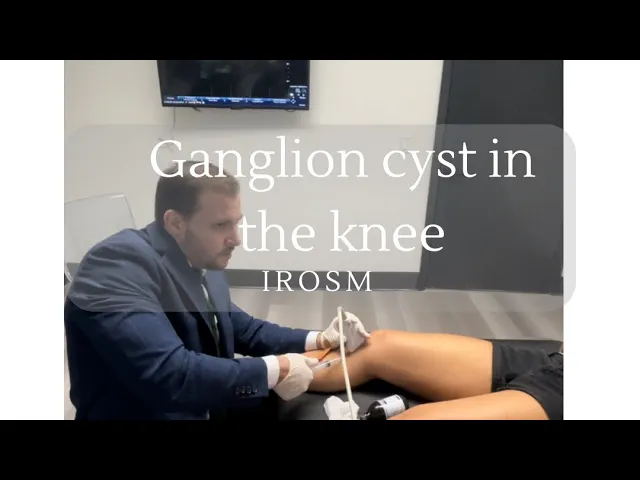
A ganglion cyst in the knee is a sac filled with thick, jelly-like fluid. It can grow from the joint lining, a tendon sheath or a ligament. Some sit outside the joint, for example on the outer side of the knee near the top of the fibula. Others sit inside the joint, often on the ACL, where they may cause pain or limit how far the knee bends or straightens.
The cause is often unclear. Some appear after an injury or repeated stress on the knee. Many are found by chance on an ultrasound or MRI and never need treatment. When a cyst causes pain or limits movement, drainage or other treatment may be considered after an evaluation.
A meniscal cyst forms when joint fluid is pushed through a tear in the meniscus, the C-shaped cartilage cushion in the knee, and collects in a pocket. When the pocket extends beyond the edge of the meniscus, it is called a parameniscal cyst. It is usually linked to a horizontal tear and is more common on the outer (lateral) side of the knee.
A parameniscal cyst often feels like a firm lump along the joint line that is easier to see with the knee bent. Because the tear is usually the source of the fluid, care often focuses on the meniscus as well as the cyst. Learn more about meniscus tear treatment in Fort Lauderdale.
Several kinds of cyst can form around the knee. They can look alike from the outside, so imaging is usually needed to tell them apart and plan care.
Thick, jelly-like fluid. Can form inside the joint (often on the ACL) or outside it. May follow an injury or repeated stress, or appear with no clear cause. Cysts on a ligament may be seen alongside knee ligament tears.
Joint fluid pushed out through a meniscus tear. Usually felt along the joint line, often on the outer side of the knee. Care may address both the cyst and the tear.
Extra joint fluid that bulges into the back of the knee, often linked to knee arthritis or a meniscus tear. See our page on Baker’s cyst treatment.
Bursitis, a swollen tendon, a blood clot behind the knee or, rarely, a tumor can look similar. That is why a new or growing lump should be examined.
Many knee cysts cause no symptoms. When they do, symptoms depend on the cyst’s size and where it sits:
Seek prompt care if your calf becomes swollen, warm, red or very painful, because these can be signs of a blood clot or a ruptured cyst.
Diagnosis starts with your history and a hands-on exam. At IROSM, Dr. Gonzalez then uses ultrasound for orthopedics and sports medicine in the office. Ultrasound shows whether a lump is filled with fluid, how large it is, where it connects, and whether blood vessels or nerves are nearby.
An MRI may be recommended when a cyst sits inside the joint or when a meniscus or ligament tear needs a closer look. The imaging results help decide whether a cyst can be watched, drained, or needs a surgical opinion.
Treatment depends on the type of cyst, your symptoms and any problem inside the knee. Options discussed at an evaluation may include:
If a cyst causes no pain or limits nothing, monitoring it may be reasonable. Some cysts shrink or go away on their own.
Reducing deep squatting and kneeling for a while, plus strengthening, may help ease symptoms in some patients.
Dr. Gonzalez numbs the area and uses ultrasound to guide a needle into the cyst and draw out the fluid, sometimes followed by an injection. This is done in the office, without surgery. Read how image-guided injections support precise needle placement.
When a meniscus tear or arthritis is driving the cyst, care may also address that problem. For some patients, PRP therapy may be discussed as a non-surgical option for the underlying knee condition.
Cysts can come back after drainage, especially when a meniscus tear is still present. If a cyst keeps returning or symptoms continue, surgical removal or arthroscopic treatment of the tear may be discussed, and Dr. Gonzalez can help you understand when a surgical opinion makes sense. Whether you are a candidate for drainage is decided after your exam and ultrasound.
Dr. Gonzalez explains knee ganglion cysts in the video at the top of this page. In this second video, he explains parameniscal cysts and in-office drainage. Every case is different, and results vary.

Providing knee cyst evaluation and ultrasound-guided drainage to residents in Fort Lauderdale, Pompano Beach, Plantation, and Broward County. For our Hialeah office, se habla español.
Institute of Regenerative Orthopedics & Sports Medicine (IROSM)
3333 West Commercial Blvd, Suite 101
Fort Lauderdale, FL 33309
Phone: (954) 751-6990
Triple board-certified · Fellowship-trained at the Andrews Institute · Fort Lauderdale & Hialeah
Schedule a consultation with Dr. Jorge Gonzalez at IROSM in Fort Lauderdale to find out whether ultrasound-guided knee cyst drainage is right for your condition.
Book Your Appointment Now: (954) 751-6990 Make an Inquiry Online
Disclaimer: This content is for general educational purposes and does not constitute formal medical advice. Individual patient outcomes will vary. Knee cyst drainage at IROSM in Fort Lauderdale requires a clinical examination by Dr. Jorge Gonzalez to establish candidacy. Serving Fort Lauderdale, Pompano Beach, Plantation, and surrounding Broward County communities.