- info@irosm.com
- 3333 West Commercial Blvd , Ste 101 Fort Lauderdale , Fl, 33309

A dislocated finger is one of the most common hand injuries seen in sports and everyday accidents, and it is also one of the most urgent. If your finger is visibly out of place, swollen, or will not move normally after a fall, a ball, or a collision, same-day evaluation matters more than almost any other hand condition on this site.
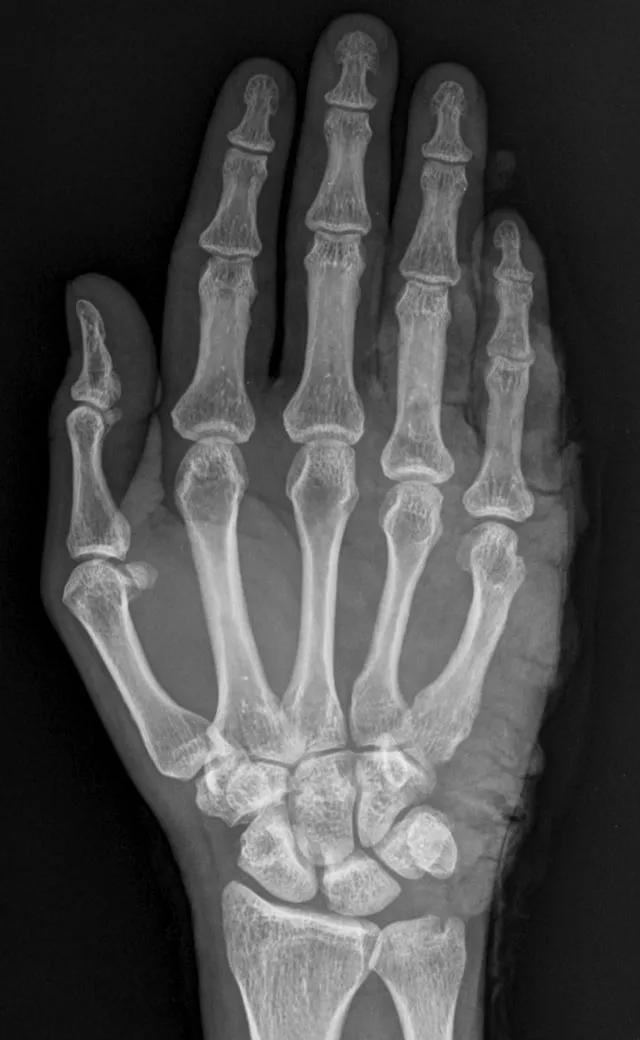
A finger dislocation happens when the bones that form one of the finger’s joints are forced out of their normal alignment, most often at the middle joint (the PIP joint) or, less commonly, the joint closest to the fingertip (the DIP joint) or the base knuckle (the MCP joint). The proximal interphalangeal, or PIP, joint is the most frequently dislocated joint in the hand.
The usual cause is a direct blow to an extended finger: catching a ball awkwardly, jamming a finger against an opponent, or bracing a fall with an outstretched hand. The force pushes the joint past its normal range, and the ligaments that hold it in place stretch or tear in the process.
Common symptoms of a dislocated finger include:
Finger dislocations, jammed finger sprains, and small fractures can look and feel similar in the first hours after an injury, and it is common for more than one of these to be happening at the same time, for example a dislocation with an accompanying fracture at the joint surface.
Trying to diagnose this at home, or attempting to pop the joint back into place yourself, is not recommended. An incorrectly reduced joint, or a missed fracture, can lead to worse stiffness and instability later. An in-person exam with imaging is the only reliable way to tell these apart.
At IROSM’s Fort Lauderdale orthopedic walk-in clinic, a finger dislocation evaluation typically includes:
Some patients recover full motion without any lasting issue. Others are left with residual stiffness, ligament laxity, or joint pain weeks or months after the initial injury heals, sometimes progressing toward post-traumatic arthritis in that joint over time.
For patients in this situation, IROSM also evaluates non-surgical orthobiologics options, including image-guided injections to precisely target the affected joint and PRP therapy, a regenerative option using components drawn from your own blood. Whether either approach fits your joint and your stage of recovery is something Dr. Gonzalez determines at evaluation, not something this page can tell you in advance.
If the finger involved was the thumb, or if arthritis develops at the base of the thumb after a joint injury, see our page on thumb arthritis (CMC). Patients recovering from a finger dislocation sometimes also develop catching or locking symptoms unrelated to the original injury, covered on our trigger finger page, and hand injuries can sometimes come with wrist symptoms worth ruling out, covered on our carpal tunnel page.
A finger that “looks fine after a few days” can still be hiding a ligament injury or a subtle fracture that will only show up as stiffness or instability months later. IROSM’s orthopedic walk-in clinic and sports medicine program exist specifically for injuries like this: an evaluation the same week the injury happens, from a physician who treats hand and sports injuries regularly, rather than a delayed diagnosis after the joint has already stiffened up.
Fort Lauderdale (primary location): 3333 West Commercial Blvd, Suite 101, Fort Lauderdale, FL 33309. Call (954) 751-6990 for same-day availability.
Patients in Miami-Dade can also be seen at our Hialeah location, 777 E 25th St, Suite 508, Hialeah, FL 33013. Se habla español. For Spanish-language hand-condition information, see ¿Tienes miedo de la cirugía del túnel carpiano?
Some insurance plans need a referral, so please check with your plan before your visit.
Rated 4.9 out of 5 by patients across both locations
Dislocated a finger and not sure what to do next? Make an inquiry online or call (954) 751-6990 for same-day evaluation at IROSM in Fort Lauderdale.

Important notice: Finger dislocation care, including whether reduction, splinting, hand therapy, or a follow-up regenerative option is appropriate, is determined through an in-person evaluation with imaging. Dr. Gonzalez determines the right approach for your specific joint and injury. Individual healing time varies.