- info@irosm.com
- 3333 West Commercial Blvd , Ste 101 Fort Lauderdale , Fl, 33309

A sudden, sharp pain in the back of the calf during a lunge or sprint can be tennis leg, a tear of the calf muscles. It often feels like being kicked, and it is common in racket sports, running and other active pursuits. An evaluation helps confirm the injury, rule out other causes of calf pain, and plan your return to activity.
At the Institute of Regenerative Orthopedics & Sports Medicine (IROSM), Dr. Jorge Gonzalez, MD at IROSM in Fort Lauderdale uses in-office ultrasound to see the tear and build a non-surgical care plan for appropriate candidates.
Book Your Appointment Now: (954) 751-6990 Make an Inquiry Online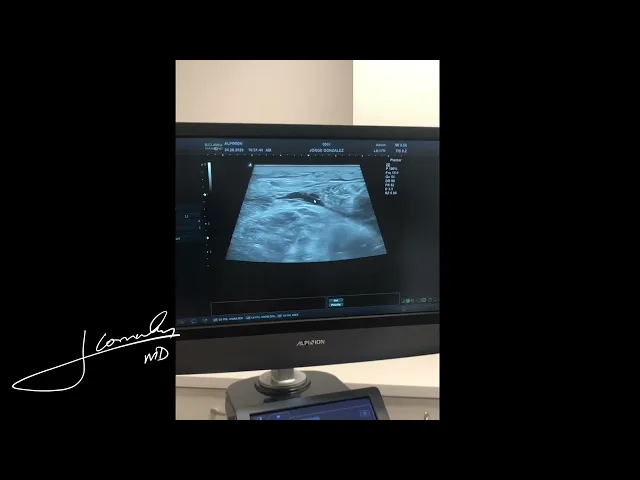
Tennis leg is a tear or strain of the calf muscles, usually the inner (medial) head of the gastrocnemius where it joins the Achilles tendon area. Less often it involves the soleus muscle underneath or the small plantaris tendon. Despite the name, it is not limited to tennis. It often happens during a sudden push-off, lunge or sprint, in sports such as tennis, pickleball, running and basketball, and is more common from middle age onward.
Tennis leg is often confused with an Achilles tendon tear, which is a different injury that affects the tendon lower down near the heel. An exam and ultrasound help tell them apart. Learn more about Achilles pain and its treatment.
Calf pain and swelling can also come from a blood clot in a leg vein (deep vein thrombosis) or a ruptured Baker’s cyst. These can look similar to a calf tear, so a new, painful, swollen calf should be checked promptly. Seek urgent care if you also have chest pain or shortness of breath.
Dr. Gonzalez can often diagnose a calf muscle tear in the office using ultrasound for orthopedics and sports medicine. Ultrasound shows which muscle is torn, how large the tear is, and whether blood or fluid has collected between the muscles (a hematoma). It can also help check the Achilles tendon and look for other causes of calf pain.
Knowing the size and location of the tear helps set a sensible plan for rest, rehab and a gradual return to sport. In some cases, other imaging or testing is recommended.
Most calf muscle tears are treated without surgery. The plan depends on the size of the tear and your activity goals, and is decided at your evaluation. Options may include:
Relative rest, ice, compression and elevation, sometimes with a heel lift, a boot or crutches for a short time to take stress off the calf.
Gentle motion, then progressive strengthening and a gradual return to running and sport, guided by how the calf responds.
When a large collection of blood or fluid forms, it may be drained with a needle under ultrasound. Read how image-guided injections support precise needle placement.
For slow-healing muscle injuries, PRP therapy or MLS laser therapy may be discussed as non-surgical options to consider. Surgery is rarely needed.
Recovery time varies with the size of the tear, your age and your sport. Returning to full activity too early can raise the risk of re-injury, so a graded plan matters. Similar principles apply to other muscle injuries such as hamstring pain and strains. For sports injuries more broadly, see our sports medicine care in Fort Lauderdale.
The video at the top of this page explains what tennis leg is. In this second video, Dr. Gonzalez describes the symptoms and shows how ultrasound is used to diagnose a calf muscle tear. Every case is different, and results vary.

Providing tennis leg and calf strain evaluation and treatment to residents in Fort Lauderdale, Pompano Beach, Plantation, and Broward County. For our Hialeah office, se habla español.
Institute of Regenerative Orthopedics & Sports Medicine (IROSM)
3333 West Commercial Blvd, Suite 101
Fort Lauderdale, FL 33309
Phone: (954) 751-6990
Triple board-certified · Fellowship-trained at the Andrews Institute · No referral needed
Schedule a consultation with Dr. Jorge Gonzalez at IROSM in Fort Lauderdale to find out what is causing your calf pain and which tennis leg treatment is right for your condition.
Book Your Appointment Now: (954) 751-6990 Make an Inquiry Online
Disclaimer: This content is for general educational purposes and does not constitute formal medical advice. Individual patient outcomes will vary. Tennis leg treatment at IROSM in Fort Lauderdale requires a clinical examination by Dr. Jorge Gonzalez to establish candidacy. Serving Fort Lauderdale, Pompano Beach, Plantation, and surrounding Broward County communities.