- info@irosm.com
- 3333 West Commercial Blvd , Ste 101 Fort Lauderdale , Fl, 33309

A swollen knee can feel tight, painful and hard to bend. The swelling is usually extra fluid in the joint, and finding out why it is there is the first step. In some patients, draining the fluid may help ease pressure and helps confirm the cause.
At the Institute of Regenerative Orthopedics & Sports Medicine (IROSM), Dr. Jorge Gonzalez, MD at IROSM in Fort Lauderdale uses ultrasound to look at knee swelling in the office and, for appropriate candidates, to guide a needle and drain the fluid. Watch him demonstrate it in the video; results vary.
Book Your Appointment Now: (954) 751-6990 Make an Inquiry Online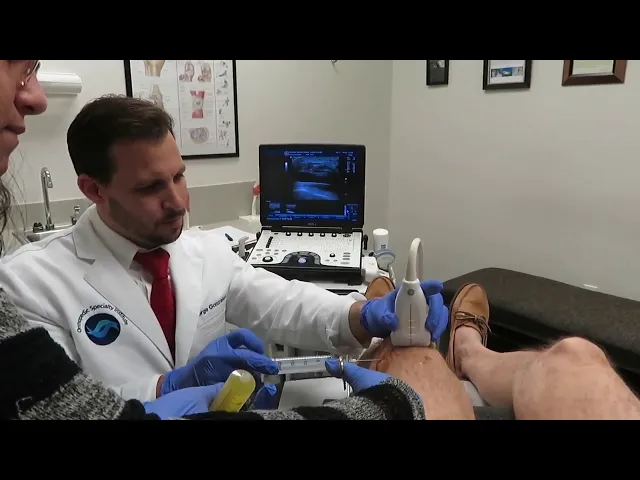
A swollen knee usually means extra fluid has built up inside the joint. Doctors call this a knee effusion; many patients call it water on the knee. The swelling is a sign that something is irritating the joint, so the goal of an evaluation is to find the cause, not only to remove the fluid.
Knee arthritis is one of the most common reasons for a knee that swells again and again. Gout and pseudogout, where crystals form in the joint, can also cause sudden, painful swelling.
A twist or fall can damage the meniscus or a ligament. Meniscus tears and knee ligament tears often cause swelling within hours to a day or two. Rapid swelling after an injury can mean bleeding inside the joint.
Fluid can also collect outside the joint. A Baker’s cyst forms behind the knee, and bursitis can cause a soft swelling over the kneecap. Ultrasound helps tell these apart from true joint fluid.
Some swelling is expected while healing, but swelling that returns or persists long after surgery should be checked. Read about whether a loose knee replacement can be fixed without surgery.
These can be signs of an infection or a serious injury, which need prompt medical attention.
Knee aspiration (also called arthrocentesis) uses a needle to draw fluid out of the joint. It may be recommended for two reasons, and often both apply:
The fluid can be sent to a lab to look for crystals (gout or pseudogout), signs of infection, or blood. This can change which treatment makes sense.
Removing a large amount of fluid may help reduce pressure, pain and tightness, and may make it easier to bend and straighten the knee.
Draining the fluid may help in the short term, but fluid can build up again if the cause is not addressed. That is why aspiration is usually one part of a wider plan. Whether it is a good option for you is decided at your evaluation.
Dr. Gonzalez uses ultrasound for orthopedics and sports medicine in the office. Ultrasound shows exactly where the fluid is, how much there is, and where nearby structures sit, so the needle can be guided into the fluid pocket in real time. It can also show whether swelling is inside the joint, in a bursa, or in a cyst.
The procedure is generally well tolerated. Possible risks include soreness, bruising, bleeding and, rarely, infection. Learn more about how image-guided injections help with accurate needle placement.
Once the cause is clearer, treatment is matched to it. Depending on the diagnosis, options may include activity changes, a brace, physical therapy, medication for gout or inflammatory arthritis, or an injection. For patients with arthritis or certain soft tissue injuries, regenerative options such as PRP therapy or stem cell injections for knees may be discussed as non-surgical options to consider. Some injuries need a surgical opinion, and Dr. Gonzalez can help you understand when that makes sense.
Providing knee swelling evaluation and ultrasound-guided knee aspiration to residents in Fort Lauderdale, Pompano Beach, Plantation, and Broward County. For our Hialeah office, se habla español.
Institute of Regenerative Orthopedics & Sports Medicine (IROSM)
3333 West Commercial Blvd, Suite 101
Fort Lauderdale, FL 33309
Phone: (954) 751-6990
Triple board-certified · Fellowship-trained at the Andrews Institute · No referral needed
Schedule a consultation with Dr. Jorge Gonzalez at IROSM in Fort Lauderdale to find out what is causing the swelling and whether ultrasound-guided knee aspiration is right for your condition.
Book Your Appointment Now: (954) 751-6990 Make an Inquiry Online
Disclaimer: This content is for general educational purposes and does not constitute formal medical advice. Individual patient outcomes will vary. Knee aspiration at IROSM in Fort Lauderdale requires a clinical examination by Dr. Jorge Gonzalez to establish candidacy. Serving Fort Lauderdale, Pompano Beach, Plantation, and surrounding Broward County communities.